
Recess or Photo?
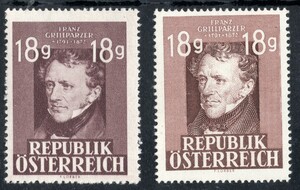
A general guide for distinguishing "recess" and "photo" :
I am often asked about how to distinguish between these two printing processes. Especially when the Austrian "Franz Grillparzer" stamp of 1947 was produced in two variants, one "recess" and one "photo"
Recess refers to the hand-etched lines on the engraved printing plate. The lines for ink are cut into the plate by hand, or from a steel die, the plate is inked and then scraped by a blade, leaving ink only in the recessed lines and with the "white" areas scraped clean. Pressed onto paper, the ink lines transfer onto paper and slightly stand up, they are variously thick or thin according to depth of cutting. If you run a fingertip over the stamp, you can sometimes feel the lines of ink on the paper surface
(However, not so evident on this Grillparzer stamp, but can be a clue on older stamps). Examples : the Penny Black or QV 1d reds. The detail is always very clear, whether light or dark shade in the design, all the lines are distinct.
"Photo" = either an image is photographed through a screen of dots to produce a coarse typographed image made for traditional typo printing (like pictures made of dots in an old newspaper, though not often used for stamps); OR photolitho (same system but finer dots, for lithograph printing, part of the plate is photographically developed (image area) and part not developed ("white" area), ink and water applied at the same time by rollers, and only the ink stays on the image area; OR photogravure (same idea as photolitho but the inked area is additionally enhanced by an extremely fine etched screen to give some gradation of light and shade. In all cases, "Photo" stamps feel flat. Examples : the "photogravue" of GB KGV definitives from 1934 onwards plus the KGVI definitives. Often "photo" stamps of any style appear over-inked and detail a bit blotchy.
If eye sight is not enough, a glass magnifier should make the differences apparent, or I use a computer scanner which is great for making more detailed magnifications.
In the case of the Grillparzer stamp, one is all photo therefore same colour ink all over. The other one, called "recess" in SG, usually has more contrast between the frame (light shade) and the central head (darker). Despite what SG says, the colour of the ink is about the same for both issues, though in the recess one the pale parts of the design are paler because the engraved printing process keeps these differences more accurately. For example, the frame of the recess stamp often appears lighter than the photo one, because the engraved lines keep the white parts between the inked lines still distinct and separate. With photo, the grain of dots blur together evenly. Also, the collar below the head always shows the printing differences clearly too : the photo one has a smudge of fine dots in this area, but the recess one has clear engraving lines on the collar. Finally, Grillparver's hair is more clearly showing lines of curls in the recess one.
Printing terms can be complex. I normally call "recess" stamps as "engraved" or "line engraved" because it describes the printing process more accurately. In some technical printing journals or books, "photogravure" is just called "gravure" for short, which is misleading for philatelists, but in philately the term "photo" is more common in order to highlight the difference from stamps produced by a hand etched design from those where a photographic process is used.